
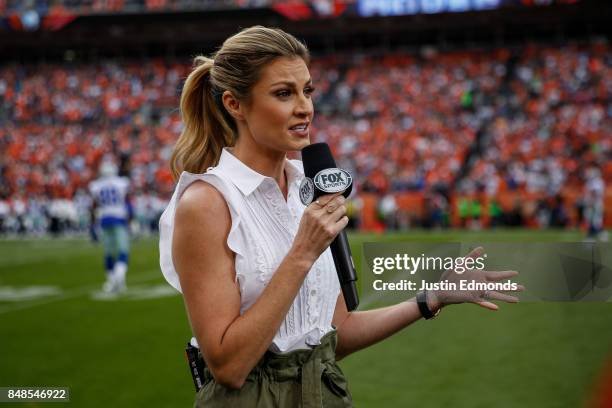
If you shoot sports long enough, you notice how the broadcast sets the rhythm of the pictures we chase. Few broadcasters have shaped that rhythm like Erin Andrews. Her sideline presence doesn’t just narrate a game—it nudges photographers toward specific beats: the tunnel walk, the quick reaction, the bench whisper, and that essential context frame that stitches it all together. I’ve felt it on small local fields here in Nepal and while covering bigger matches abroad: the camera goes where the story goes, and often the story arrives right where the mic already is.
How broadcasters influence the sports photo narrative
When Erin Andrews hits the sideline for a report, producers cut to her close-up, then to players, coaches, or fans she’s referencing. Photographers mirror that cadence visually. We plan short sequences: broadcaster cutaway → coach reaction → player detail → crowd context. It’s the same story, told in stills.
If you want to dig deeper into how TV coverage shapes imagery, I wrote about it here: The Role of Photography in Sports Broadcasting – Fox Sports. And since you’re here for the Erin angle, you might like these related reads on NepShoot: Erin Andrews: Sports, Photography & Media, Bridging Sports and Photography, and our coverage pieces here, here, and here.
Sideline choreography: shoot the story, don’t block it
On crowded sidelines, everyone is working. Don’t drift into a broadcast frame unless you have permission, and never cut between a reporter and their subject. I try to stay back, compress with a telephoto, and layer foreground elements (mic flags, helmets, hands) to make viewers feel like they’re standing right there without me being in the way.
Technical choices matter here. Stadium light can be harsh and mixed, the action is fast, and faces turn on and off like a strobe. My baseline starting point for field-level work:
- Shutter: 1/1000–1/1600 sec for live play; 1/320–1/500 sec for sideline storytelling where you want a touch more ambient. Learn more: Shutter Speed.
- Aperture: f/2.8–f/4 for subject isolation; stop down to f/5.6 for duos (reporter + coach) in the same plane. Refresher: Aperture and Depth of Field.
- ISO: 1600–6400 under lights; expose for skin, not jerseys. Guide: ISO.
- AF: Continuous with subject-detect if available; back-button focus helps when bodies cross the frame. Read: Focusing.
- White Balance: under LED/fluoro mix, lock a Kelvin or custom WB so edits are consistent. Tips: White Balance.
Framing the “Erin cutaway” (and why it works)
The broadcaster cutaway is a gift for stills. It’s often a calm moment in chaos—a composed face, direct eyes, clear body language. I’ll place the reporter roughly on a third, then layer the narrative: a coach’s shoulder in the foreground, players racked out behind, the parabolic mic dish catching a highlight. Shallow DOF keeps it clean, but don’t erase context. That balance is the look that editors pick every time.
Lighting tip: when the booth throws a spot on the sideline hit, you can get a crisp key with deep, cool stadium ambient. Expose for the faces and let the background fall a stop. If you need fill, a tiny kiss from a shoe-mount at -2 EV, flagged and bounced, can help—just mind broadcast etiquette. More in Understanding Light and Fill-in Flash.
Reliable gear for the sideline
I carry two bodies and split roles: a fast tele for play and a mid-tele for storytelling. A solid monopod saves your back—mine has the scuffed feet to prove it. Here’s a kit that’s earned a place in my bag (affiliate links):
- 70–200mm f/2.8 (bread-and-butter for reporters, coaches, benches):
- Long prime for play across the field:
- 400mm f/2.8 (various mounts) on a sturdy monopod
- Support & protection:
If you’re choosing a body for this work, look at AF reliability, high ISO performance, and buffer depth. Our guide to Best Full-Frame Cameras and the overview of Camera Kits & Equipment will help.
Fast workflow: turning sideline moments into publishable stories
Broadcast moments age quickly. My routine is simple: tether or rapid-card swaps at breaks, star-rate keepers, caption with play clock and quarter, then export two crops—one tight for thumbnails, one wider for social. AI can help, but keep it light-handed.
- Noise & detail: Lightroom AI Denoise or Topaz Photo AI at low settings preserves texture.
- Speed edit: create a game-day preset for stadiums you shoot often (WB, tone curve, color mix).
- Composition: try subtle generative expand only for edge fixes, not for content changes.
For the full back-end, see Post-Production and why I still prefer Working in RAW for night games.
Ethics and access
Reporters like Erin are doing a job under tight timing. Give space, be predictable, and respect security lanes. Never crowd an interview, and don’t publish frames that compromise safety, strategy, or dignity. If in doubt, hand it to your editor with context.
Quick sideline checklist
- Two bodies: one with 400mm/300mm, one with 70–200mm.
- Monopod, rain cover, microfiber, gaffer tape.
- Custom WB, AF-C with subject detect, minimum shutter set.
- Caption template ready; lens cloth in non-dominant pocket.
- Know where the broadcast is staging hits; pre-compose your cutaways.
Bottom line: Erin Andrews—and the broadcast energy she represents—has sharpened how we frame sideline storytelling. It’s a dance between camera and commentary. When you anticipate that rhythm, your stills feel like part of the live show, not just next to it.
PS: If you’re building your kit from scratch, skim our primers on The Essentials of Photography, choosing the Right Lenses, and balancing Exposure. Good fundamentals make the frantic stuff easier.
Transparency note: Some product links above are affiliate links. If you buy through them, we may earn a small commission at no extra cost to you. It helps keep NepShoot ad-light and field-heavy.